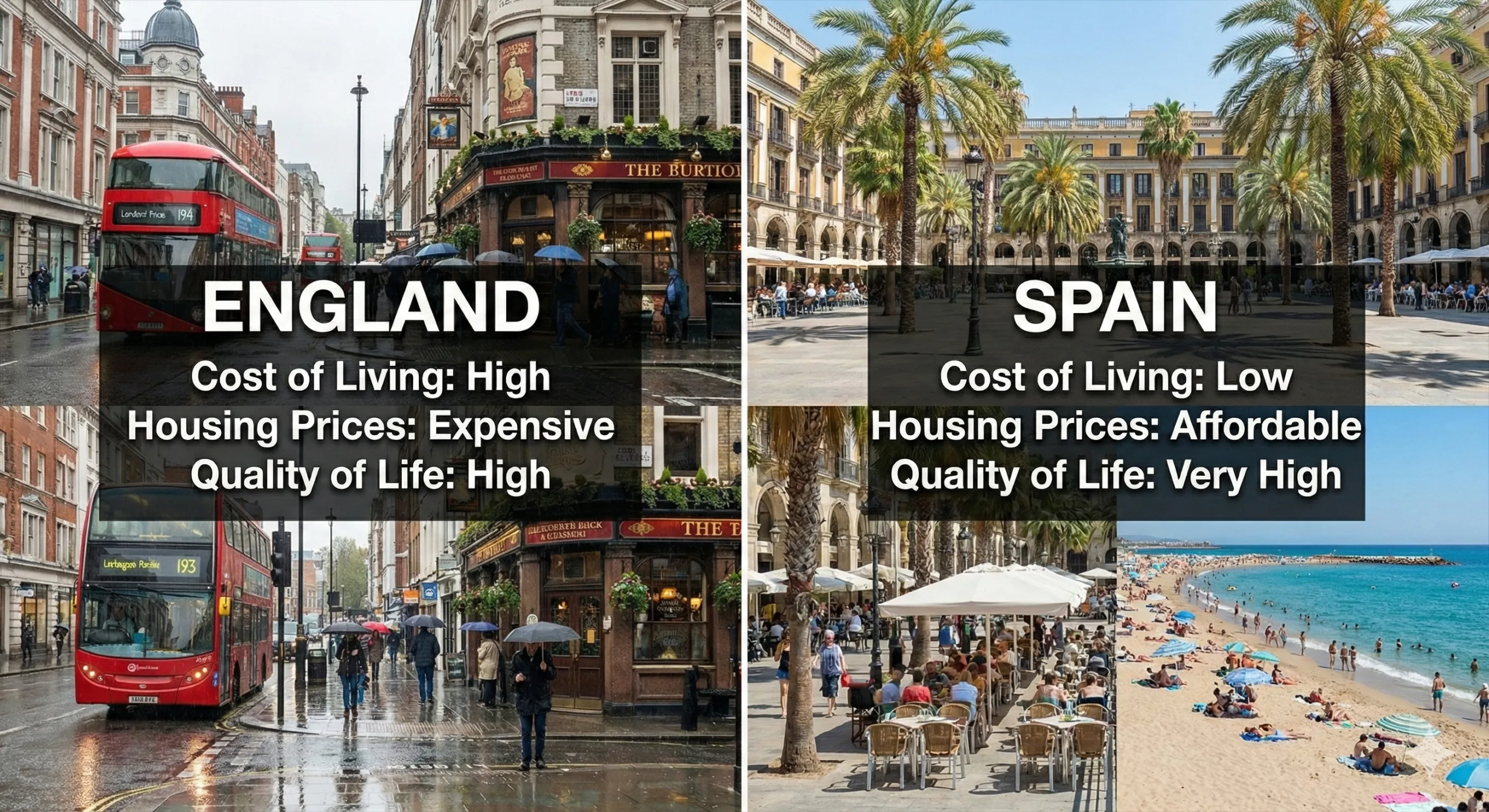
1. Overview: How Much Cheaper Is Spain Than England?
If you’re considering a move from England to Spain, cost of living is often the first question. How much cheaper is it really to live in Spain, and how does the difference affect property prices, everyday expenses and quality of life?
On average, the cost of living in Spain is 30–40 % lower than in England, and in certain city-to-city comparisons the difference can exceed 50 %. This gap means that many British expats and retirees can achieve significantly greater purchasing power, a better housing standard and a more flexible lifestyle — particularly in popular regions such as the Costa del Sol.
In this guide we compare the most important differences between Spain and England across housing costs, groceries, transport, utilities and lifestyle. We also examine how living costs affect property investment and home purchases for British buyers considering a move or holiday home in Spain.
- Spain is roughly 30–40 % cheaper than England across all major categories
- Property prices on the Costa del Sol are up to 60 % lower than in London
- Restaurant and grocery prices are 30–50 % lower in Spain
- Rental yields on the Costa del Sol typically run 5–7 % (vs. 3–5 % in London)
- More than 300 days of sunshine per year on the Costa del Sol
| Category | Spain (avg.) | England (avg.) |
|---|---|---|
| Overall price index (excl. rent) | Ca. €710/mo. | Ca. €1,100/mo. (£940) |
| 1-bed flat, city centre | €700–€1,200/mo. | €1,050–€2,700/mo. (£900–£2,300) |
| Groceries (couple) | €250–€400/mo. | €400–€600/mo. (£340–£510) |
| Restaurant meal (mid-range, 2 pers.) | €35–€50 | €70–€95 (£60–£80) |
| Utilities (85 m² flat) | €100–€150/mo. | €200–€350/mo. (£170–£300) |
| Monthly transport pass | €40–€55 | €80–€175 (£70–£150) |
| Avg. property price/m² | €2,000–€5,400 | €2,800–€9,000 (£2,400–£7,700) |
Overall, the data shows that housing and restaurant costs drive the largest share of the difference between England and Spain, while transport and utilities contribute secondarily. For a British household, housing costs alone represent the single biggest saving when relocating to Spain.
2. Comparing Housing Costs
Housing is by far the largest single expense in both countries, and it is also where the difference between Spain and England is most dramatic. Renting a one-bedroom flat in a Spanish city centre typically costs between €700 and €1,200 per month. Move outside the centre and prices fall to €500–€850. In smaller towns and coastal resorts along the Costa del Sol (Málaga, Fuengirola, Mijas, La Cala de Mijas) you can still find quality homes for under €900.
In England, the picture looks entirely different. Rent in London for a comparable one-bedroom flat starts at around £1,800 (€2,100) in the centre and can easily exceed £2,500 (€2,900) for newer or well-located properties. Even northern cities like Manchester (£950–£1,400) and Liverpool (£700–£1,200) carry significantly higher rents than the Costa del Sol, despite offering a fraction of the sunshine hours.
The difference becomes even clearer with specific city comparisons. A flat in Málaga can cost up to 50 % less than a comparable property in London, while international demand continues to rise. In Estepona, you can find modern apartments at prices equivalent to a terraced house in a Manchester suburb — but with a Mediterranean climate and the beach on your doorstep. Similarly, Fuengirola offers contemporary homes at price points that would barely cover a modest flat in Liverpool city centre.
For property buyers, the implications are even more striking. An 85 m² flat in central London typically costs £650,000–£850,000 (€760,000–€995,000), while a comparable flat in a well-connected Costa del Sol town like Fuengirola or La Cala de Mijas would cost between €250,000 and €380,000 — less than half the London price.
3. Grocery Prices
Spain benefits enormously from its position as a major agricultural producer. Fresh fruit, vegetables, olive oil and seafood are not only of outstanding quality but also competitively priced. Couples typically spend €250–€400 per month on groceries, and shopping at local markets can push that figure even lower. The famous “menú del día” lunch offering three courses including a drink typically costs €10–€15.
In England, grocery prices are among the highest in Europe. A 20 % VAT rate on many products and the country’s dependence on food imports mean that a comparable household typically spends £340–£510 (€400–€600) per month. Budget-conscious shoppers head for Aldi, Lidl and Tesco value ranges, but even these prices sit noticeably above their Spanish equivalents.
As a rule of thumb, groceries in Spain are roughly 30–40 % cheaper than in England. The difference is particularly pronounced for fresh vegetables, fruit, olive oil, meat and seafood.
4. Restaurants and Eating Out
Eating out is one of Spain’s greatest lifestyle advantages. Tapas bars offer dishes for €3–€6 each, and a full dinner at a mid-range restaurant rarely exceeds €25 per person. Even fine dining is remarkably accessible compared with England.
England is one of the most expensive countries in Europe for eating out. A meal at an inexpensive restaurant in London costs around £15–£22 (€18–€26), while a three-course dinner for two at a mid-range restaurant easily reaches £60–£80 (€70–€95). Even outside London, prices in Manchester and Liverpool are substantially higher than comparable Spanish restaurants. Overall, restaurant prices in Spain are roughly 40–50 % lower than in England.
5. Utility Costs
For a standard 85 m² flat, basic utilities (electricity, water, heating and waste collection) in Spain cost between €100 and €150 per month. Southern Spain’s mild winters mean minimal heating costs for most of the year, and many households only need air conditioning during the hot summer months of July and August. Internet packages typically add €25–€45.
In England, utility costs are significantly higher, typically £170–£300 (€200–€350) per month for the same size flat. Energy bills have soared in recent years following global price shocks, and heating is a substantial cost during the long British winter. Internet service runs a similar £25–£45, so broadband costs are comparable, but the overall utility bill is 40–70 % higher in England.
6. Transport
Public transport in Spanish cities is efficient and affordable. Monthly passes typically cost €40–€55, and intercity travel by high-speed train or bus is competitively priced. Car ownership is common on the Costa del Sol, with fuel prices and insurance costs modest compared with England.
England’s public transport is extensive but expensive, particularly in London, where a monthly Travelcard costs £150+ (€175+) depending on zones. Even in Manchester and Liverpool, monthly passes run £70–£100. Car ownership in England comes with high insurance premiums, road tax and among the most expensive fuel in Europe. The overall transport cost in Spain is roughly 30–50 % lower than in England.
7. Lifestyle Differences
Beyond the numbers, the lifestyle shift from England to Spain is considerable. Spain offers over 300 days of sunshine per year on the Costa del Sol, a deeply social outdoor culture and a pace of life that prioritises wellbeing. Gym memberships, cinema tickets and leisure activities are generally 20–40 % cheaper than in England.
Healthcare is another important factor. Spain’s public health system (Sistema Nacional de Salud) offers free or low-cost treatment for registered residents, and private health insurance is remarkably affordable — typically €50–€200 per month depending on age and cover level. Since Brexit, British residents in Spain no longer have automatic access to the NHS-funded healthcare they were used to, but Spain’s healthcare system is consistently ranked above the UK’s by the WHO, and private cover at Spanish prices is typically far cheaper than equivalent UK private insurance.
Spain’s vibrant food culture, outdoor festivals, beach access and overall quality of life are consistently cited by British expats as the primary motivations for moving — even ahead of the cost savings.
This combination of climate, lower living costs and high quality of life is one of the main reasons why British buyers continue to be the single largest group of international property purchasers in Spain, year after year.
8. Property Prices: Costa del Sol vs England
From an investment perspective, the difference in property prices between England and Spain is one of the most important drivers behind the growing international buyer interest. In 2025 property prices on the Costa del Sol continued their upward trend, yet they remain dramatically lower than in England’s major cities.
| Location | Avg. €/m² (2025) | Annual growth |
|---|---|---|
| Málaga, Spain | €3,200–€3,800 | +12–14 % |
| Marbella, Spain | €5,200–€5,400 | +9 % |
| Estepona, Spain | €3,600–€4,200 | +5–6 % |
| Fuengirola, Spain | €3,500–€4,300 | +12–19 % |
| London (avg.), England | €7,700–€9,000 (£6,600–£7,700) | -1 to +2 % |
| Manchester, England | €3,600–€4,300 (£3,100–£3,700) | +3–5 % |
| Liverpool, England | €2,800–€3,400 (£2,400–£2,900) | +4–6 % |
In practical terms, the budget required to buy a two-bedroom flat in London could secure a spacious three-bedroom apartment with sea views on the Costa del Sol — or even a modern townhouse with a communal pool in areas like La Cala de Mijas or Mijas Costa. Someone spending at Manchester price levels could acquire a high-quality holiday home in Estepona, complete with resort-style amenities and year-round sunshine. And a buyer at Liverpool prices could secure a modern apartment in Fuengirola with strong rental income potential — at comparable or lower cost, but with dramatically better weather and lifestyle.
9. Investment Implications
For property investors, the Costa del Sol offers a rare combination of strong capital appreciation, healthy rental yields and lower entry prices. Property values in Málaga province have risen by approximately 12–14 % year-on-year, with towns like Fuengirola and Benalmádena recording double-digit growth. Rental yields along the coast typically run 5–7 %, compared with approximately 3–5 % in London and 5–7 % in northern English cities — but at significantly lower purchase prices.
International buyers — led by the British, followed by Scandinavians, Germans and Dutch — account for roughly 34 % of all property transactions in Málaga province, and in Marbella’s luxury segment the share exceeds 80 %. British buyers remain the single largest foreign purchaser group in Spain, completing 5,731 transactions in the first half of 2025 alone (8.1 % of all foreign sales). The strong demand is underpinned by limited building land, strict planning regulations and the enduring lifestyle appeal of 300+ days of sunshine.
England’s property market has shown more mixed performance. London prices have been essentially flat or slightly declining over the past year, while northern cities like Manchester and Liverpool are growing at 3–6 %. Transaction costs in England — including Stamp Duty (up to 12 % for additional properties), solicitor fees and surveys — can be substantial, and the overall risk-return profile is less favourable for investors seeking income-generating assets in a high-sunshine market.
Why Costa del Sol property is more affordable
Several structural factors explain the price gap. Spain’s lower average wages naturally translate into more accessible property prices. Construction costs, land values outside prime locations and local taxation are all lower than in England. Additionally, Spain’s broader housing stock offers more variety: new builds, resale apartments, townhouses and villas across a wide price spectrum. The result is a market that is both accessible for first-time overseas buyers and attractive for experienced investors seeking solid returns.
10. Conclusion
Moving from England to Spain is, measured against virtually every economic parameter, a step towards significantly lower living costs. Groceries, restaurant meals, utilities, transport and above all housing are all substantially cheaper. On the Costa del Sol, the combination of affordability, climate, infrastructure and quality of life creates one of Europe’s most compelling propositions for British expats and retirees.
For those considering the move, the numbers speak clearly: savings on daily living costs alone can free up budget for property investment, travel and a richer social life. And with Costa del Sol property prices still rising strongly, an early purchase in the right location offers both immediate lifestyle benefits and long-term financial upside.
That is why many British buyers use cost-of-living analyses as the first step in their decision-making process, before exploring specific residential areas on the Costa del Sol.
11. Frequently Asked Questions
How much cheaper is Spain than England overall?
On average, daily living costs in Spain are 30–40 % lower than in England. When housing is factored in, the difference can exceed 50 % in certain city comparisons, for example Málaga vs London, Estepona vs Manchester or Fuengirola vs Liverpool.
Is the healthcare system in Spain good enough for British expats?
Spain’s public health system is rated among the best in Europe and consistently outranks the UK in international comparisons. Registered residents receive free or low-cost treatment. Since Brexit, British residents must register in the Spanish system or take out private health insurance, which offers comprehensive cover for typically €80–€200 per month — considerably less than equivalent UK private policies.
Can I buy property in Spain as a British citizen after Brexit?
Yes. Brexit has not changed the right of British citizens to buy property in Spain. You will need an NIE (Número de Identificación de Extranjero), and total acquisition costs including taxes and fees typically add 10–15 % on top of the purchase price. Residency requirements for stays over 90 days are now subject to visa or residency permit rules.
Which areas on the Costa del Sol are best for British buyers?
La Cala de Mijas, Fuengirola, Mijas Costa, Marbella East and Estepona are all popular with British buyers. Each area offers a slightly different balance of price, lifestyle and proximity to international schools and amenities. British buyers have been the leading foreign purchaser group in Spain for decades, and well-established English-speaking communities exist across the Costa del Sol.
Are Costa del Sol property prices still rising?
Yes. By late 2025, average asking prices in Málaga province approached €3,850 per square metre, a rise of approximately 14 % year-on-year. Experts forecast continued moderate growth of 3–9 % annually, underpinned by limited supply and sustained international demand.
What about taxes when moving from England to Spain?
The UK and Spain have a double taxation agreement, so you will not be taxed twice on the same income. Spanish income tax rates for residents are progressive (19–47 %), and non-residents pay a flat rate on Spanish-sourced income. Pension taxation depends on the type of pension and treaty provisions. Since Brexit, some pension and benefit arrangements have changed, so professional tax advice is strongly recommended before making the move.
How much does it cost to live comfortably in Spain as a British retiree?
A British retiree can typically live comfortably in Spain for €1,200–€1,800 per month, including rent, groceries, utilities and leisure. On the Costa del Sol it is possible to achieve a high quality of life on a budget that would feel tight in English cities like London, Manchester or Liverpool.
How do property prices compare between London, Manchester, Liverpool and the Costa del Sol?
London is by far the most expensive at €7,700–€9,000 per m² on average, making even Marbella (€5,200–€5,400/m²) look affordable. Manchester (€3,600–€4,300/m²) is comparable to Estepona, while Liverpool (€2,800–€3,400/m²) is in a similar range to Fuengirola — yet the Costa del Sol offers 300 days of sunshine, a thriving international community and strong rental demand from year-round tourism.